31 August 2009
DB indices
I think it'd be pretty nifty to get a daily summary of which indices lead to the fastest replay of yesterday's logs, based on IO and RAM requirements. Anyone know of any tools for doing this?

27 May 2009
Ruby's memcache-client 1.7.2 does NOT support compression; patch it in with 7 lines of code
The Ruby memcache-client 1.7.2 code seems like the most popular memcached client. Alas, memcache-client 1.7.2 does not recognize :compress => true, all the demos out there notwithstanding.
Let's fix this by monkeypatching Zlib compression into Marshal.
require 'zlib'

module Marshal
  @@load_uc = method :load
  @@dump_uc = method :dump
  def self.load(v) @@load_uc[Zlib::Inflate.inflate(v)] end
  def self.dump(v) Zlib::Deflate.deflate(@@dump_uc[v]) end
end
And there we go! Four lines of patching Marshal.load for a better memory footprint.
To dissect each phrase of that sentence:
- "Four lines": I wanted just to try how well zlib would work on my Marshalled ActiveRecord objects and html fragments, and it did so handily, almost 3:1. Indeed, the only reason I poked around at the source code is because one of my largest but still highly-compressible HTML fragments was 1.2MB, over the size limit. I've since gone back to storing large HTML fragments on disk (uncompressed), having found many more values to store in Memcached.
- "patching Marshal.load": monkeypatching Marshal is not as bad as String. Chances are, you use the Marshal format as a blob, and you keep your Marshal files to yourself (and leave external serialization to friendlier fare like JSON). So, all in all, it's much easier to change the Marshal format than mucking through the memcache-client code.
- "better memory footprint": instead of Zlib, try LZMA, with slightly smaller compressed sizes than BZIP and faster decompression times, good properties for cache compression. But Zlib is already in the standard library, so it's a good first approximation.
Thoughts?
29 March 2009
Reality
When art critics get together they talk about Form and Structure and Meaning. When artists get together they talk about where you can buy cheap turpentine. -- Picasso
24 February 2009
A Full Web Service with HTTP caching in 7 lines
Two lovely gems, sinatra and rack-cache. Sinatra is pretty easy web-service-creation, and Rack::Cache is pretty easy http caching. Together? Jubilation.
and then
There are, of course, many other fiddly bits to configure Rack::Cache with, like
It's pretty amazing: that's a real live web service, with HTTP caching, in 7 gentle lines. (I don't count the closing brace, nor the sleep 1, which is purely for effect.)
Anyone know an easier way in any other language? Either in number of lines, or in directness of code?
Also, how bad would it be to authbind that to port 80, and just let it go open to the world?
Update: It's interesting to me for the same reason PHP is interesting, both as a social commentary on the bits of plumbing we've agreed upon as useful, and as an aid to wrapping an HTTP interface around some Ada code with its own homegrown database.
require 'rubygems'
require 'sinatra'
require 'rack/cache'

use Rack::Cache

get('/quadruple/:n') {
  sleep 1
  response.headers['Cache-Control'] = 'max-age=1000000'
  (params[:n].to_i * 4).to_s
}
and then
ruby sinatra-add.rb -e productionand you're done.
There are, of course, many other fiddly bits to configure Rack::Cache with, like
use Rack::Cache, :entitystore => 'file:/tmp/' if you don't want to keep it all in a hash in memory, and :verbose => false if you don't want that in your logs, but that's basically it.It's pretty amazing: that's a real live web service, with HTTP caching, in 7 gentle lines. (I don't count the closing brace, nor the sleep 1, which is purely for effect.)
Anyone know an easier way in any other language? Either in number of lines, or in directness of code?
Also, how bad would it be to authbind that to port 80, and just let it go open to the world?
Update: It's interesting to me for the same reason PHP is interesting, both as a social commentary on the bits of plumbing we've agreed upon as useful, and as an aid to wrapping an HTTP interface around some Ada code with its own homegrown database.
01 December 2007
Top five contradictory positions of Ron Paul Graham.
1. Supports secure borders, but writes macros for variable capture.
2. Rejects conspiracy theories of 9/11, but funded a social news website full of 9/11 conspiracy theories.
3. Will launch an ad blimp in two weeks, but remains cynical about submarine-style PR campaigns.
4. Says he doesn't organize his supporters on the internet, but provides a Q&A internet forum.
5. Opposes inflation, but supports accumulator generators.
Leave more in the comments...
24 November 2007
Anti-Features?, or, Never attribute to malice what can be explained by math.
Apparently, if you buy a cheap camera, and you can't save an uncompressed picture, that's treacherous computing, that's an anti-feature.
It's not. The camera won't stop working if you correctly patch in a different chip set.
And assuming the worst, assuming that the chips are exactly the same in an expensive camera, it still doesn't matter. The native resolution is still small on the cheap camera--that's mostly what makes it cheap--so you'll be better off buying the high-resolution expensive camera.
Of course, if you really want a camera that you can program, you might like an XO that drives a Roomba.
06 June 2007
cheap illustrations.
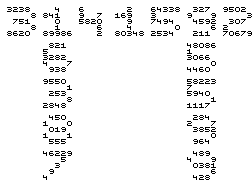
I'm a cheap nerd, so I printed myself an enormous wall decoration last August 2006: it's Pi, in a textual fractal. (This is it to two levels, and the one in my room is to five.) 3'x5', $10 from Kinko's. Nice conversation piece.
I've been printing more things recently, I've been thinking about combining text and images, and an author of two books on classical themes bemoaned the expensiveness of art in an email today. (Illustrating an book on Aesop's Fables, specifically.)
Most art schools have job boards; the artists can be of varying qualities, but sketches in pen are quick to do, and hard to do badly. (Lots of approximate lines.) Twenty seconds a sketch, which is a not-too-fast speed, scan one as you're doing the next one, and you've got a hundred in an hour.
Has anyone used Flickr for (cc)by-sa images? I wonder if that's cheaper.
I've been printing more things recently, I've been thinking about combining text and images, and an author of two books on classical themes bemoaned the expensiveness of art in an email today. (Illustrating an book on Aesop's Fables, specifically.)
Most art schools have job boards; the artists can be of varying qualities, but sketches in pen are quick to do, and hard to do badly. (Lots of approximate lines.) Twenty seconds a sketch, which is a not-too-fast speed, scan one as you're doing the next one, and you've got a hundred in an hour.
Has anyone used Flickr for (cc)by-sa images? I wonder if that's cheaper.
Subscribe to:
Posts (Atom)